

Level Design Showcase:
Portal 2: Perpetual Testing Initiative
A four chamber experience built using the Portal 2 Perpetual Testing Initiative level editor for
PROD387 - Game Level Design at the University of Canterbury
Listen to this page:
Angles, Aerials, and Antlines - Overview
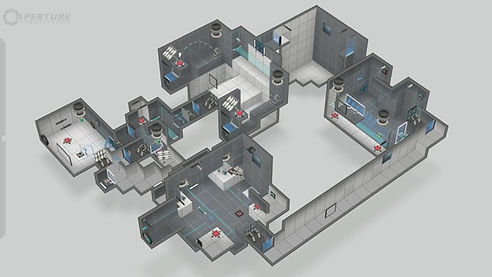
Angles, Aerials, and Antlines is a four-chamber testing track built within the Portal 2 Perpetual Testing Initiative level editor.
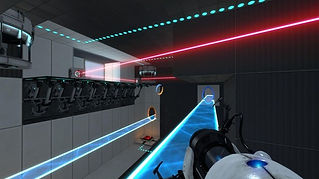
It aims to teach players about the use of the Thermal Discouragement Beam (Laser), Discouragement Redirection Cube, Hard Light Bridge, Weighted Storage Cube, and their interactions with Angled Panels and how these angles are affected by the use of portals.
The test chambers are formatted such that each main chamber is followed by a small transitional chamber to remind the player of a minor mechanic before progressing into the main puzzle.
The four chambers steadily increase in difficulty as the player progresses, with the final chamber requiring them to utilise all they have learnt, as well as backtracking to reuse elements from previous chambers.


Interative Process


Pre-Production
Concept and Planning Phase
Before beginning the creation of my level, I started by planning out what I wanted the player experience goals to be in my level, what mechanics I would include in my level, and how the player would flow through the level. From this, I created a simple flow chart and a very rough drawing of the first chamber that I wanted to implement.
During this concept phase, I also made a quick mockup of one room and asked for some feedback, with the results being that the test should be placed later in the level to give the player time to learn the mechanics present.
Iteration One
Blockout/Alpha Phase
Following the concept phase, I designed the first three of my four rooms. These initially started as separate levels, which then needed to be compiled together into one larger testing track.
The first level aims to introduce the player to the lasers and how they can be redirected with cubes or sent through portals and angled to hit a target.
The second level introduces the hard light bridge and aims to teach the player that they can block both the player character and other physics props from moving. This level included a small transition room, which was used to remind the player of the light bridge mechanic.
The third room comes directly from the concept phase and builds upon the players' understanding of the light bridge interactions.
Map Images


In-Game View


Blockout Feedback Key Takeaways:
-
Laser introduction needs more guidance
-
Poor visibility in the second room
-
Overall praise for flow and design
Map Image

In-Game View


Beta Feedback Key Takeaways:
-
First three levels were improved and well-made
-
Final room too hard and too confusing to be enjoyable
-
Navigation and player guidance need to be improved
Iteration Two
Beta Phase
In the Alpha iteration, I set out to take everything that was lacking from the Blockout and improve on it.
I retooled the first level to have a clearer placement for the cube in which to redirect the laser, expanded upon the next small room to better introduce the way bridges can interact with and block cube objects, completely reworked the way in which the player stops the cubes in the second level, and expanded upon my third level by including the laser mechanic for some further complexity and building upon the players existing knowledge.
I also created a fourth chamber for my level, which aimed to utilise everything given to the player thus far more intricately, and required the player to think outside the box to backtrack and use elements from previous rooms. However, the intended solution was unclear, the layout left players unsure of whether they were doing the right thing, and one of the mechanics required far more in-depth knowledge than should be required.
Iteration Three
Gamma Phase
For the Gamma phase, most of my focus was reworking the last level so that it was easier and the guidance was much clearer, as well as eliminating some bugs and unintended solutions from the prior three levels while keeping the core solutions the same.
I still wanted the final room to be challenging and require the player to think creatively and backtrack, so designing something that hit a balance between being thought-provoking and encouraged creative puzzle solving, but not something overly difficult, was a big challenge as a designer.
It was at this point that I started to hit the item limit frequently, so I had to be creative with the ways I guided the player and remove most of my decorative elements in favour of having more accessible puzzles. I also stripped out or simplified most of the transitional stages, making them much easier to navigate and ensuring they don't detract from the main four rooms.
Map Image

In-Game View


Gamma Feedback Key Takeaways:
-
Big improvements on the last level
-
Still needs some improvement in guidance
-
-
Overall good mix of challenge and intuition
Final Product




Full Level Walkthrough
Final Thoughts and Takeaways
From the beginning of my design, I wanted to make a level that was challenging for experienced players, as well as something that wasn't overly difficult or unintuitive for newer players. I wanted to make sure that I introduce both of my elements in a way that exposes a new use case and allows the player to experiment with the mechanics. I also wanted the final level to wrap back around to the first level and force players to think outside the box. I believe that my level has achieved this, even if the final level is more of a challenge.
The key takeaway for me from this project was the importance and value of refinement of an outcome through iteration, and that oftentimes something intuitive to the creator may be confusing to others. Having to create something that you know will be presented to your peers and critiqued forces you to try and show a product that you're proud of, and having constant cycles of iteration, review, and improvement helps to make a much more refined final product as opposed to choosing to keep the first iteration without any review. Likewise, being able to look at someone else's creation and give them a new perspective and help them identify places where players with more knowledge could do something unintentional helps them to create a more robust and polished final product as well.
I would like to extend a big thank you to both my peers who helped me test my level and to my course coordinator, Jeremy Bond, for running the playtesting workshops and giving me the opportunity to create this as part of his course.